


No results were found for the filter!



- Gewindesteigung: 0.45
- Gewinde: M2,5
- Länge: 8mm
- Kopf-Art: Zylinder
- Schlitz-Art: Phillips
- Formgröße: PH1
- Material: Stahl
- Beschichtungsmaterial: Zink
- Gewinde: M2,5
- Länge: 8mm
- Kopf-Art: Zylinder
- Schlitz-Art: Phillips
- Formgröße: PH1
- Material: Stahl
- Beschichtungsmaterial: Zink
Article no.: D7988

- Gewinde: M3
- Länge: 16mm
- Kopf-Art: Senkkopf
- Schlitz-Art: Sechskant
- Formgröße: HEX 2mm
- Material: Stahl
- Beschichtungsmaterial: geschwärzt
- Länge: 16mm
- Kopf-Art: Senkkopf
- Schlitz-Art: Sechskant
- Formgröße: HEX 2mm
- Material: Stahl
- Beschichtungsmaterial: geschwärzt
Article no.: M3X16BIN

- Gewindesteigung: 0.45
- Gewinde: M2,5
- Länge: 20mm
- Kopf-Art: Senkkopf
- Schlitz-Art: Phillips
- Formgröße: PH1
- Material: Stahl
- Beschichtungsmaterial: geschwärzt, Zink
- Gewinde: M2,5
- Länge: 20mm
- Kopf-Art: Senkkopf
- Schlitz-Art: Phillips
- Formgröße: PH1
- Material: Stahl
- Beschichtungsmaterial: geschwärzt, Zink
Article no.: D96520B


- Typ: Unterlegscheibe
- Unterlegscheibentyp: federnd
- Innendurchmesser: 2.,7 mm
- Gewinde: M 2,5
- Außendurchmesser: 5,1 mm
- Höhe: 0,6 mm
- Material: Stahl
- Unterlegscheibentyp: federnd
- Innendurchmesser: 2.,7 mm
- Gewinde: M 2,5
- Außendurchmesser: 5,1 mm
- Höhe: 0,6 mm
- Material: Stahl
Article no.: BN762



120 teiliges Abstandshalter Sortiment in Kunststoffbox.
Ideal geeignet um Erweiterungsboards mit Raspberry Pi, Arduino und Co zu verbinden.
Ideal geeignet um Erweiterungsboards mit Raspberry Pi, Arduino und Co zu verbinden.
Article no.: DBSET-M2.5

Distanzmuffe mit Gewinde, Sechskant aus Kunststoff, M2,5 (Innen und Außen-Gewinde)
Article no.: TFM-M2.5KX5

420-teiliges Abstandshalter Sortiment aus Nylon in Kunststoffbox.
Ideal geeignet um Erweiterungsboards mit Raspberry Pi, Arduino und Co zu verbinden.
Ideal geeignet um Erweiterungsboards mit Raspberry Pi, Arduino und Co zu verbinden.
Article no.: DBSET-25-NW




Kupferlitze isoliert
1-adrig, mehrdrahtig (18 x 0,1 mm)
1-adrig, mehrdrahtig (18 x 0,1 mm)
Article no.: 55045

Diese Schraube mit einem M4-Gewinde und einer Länge von 10mm eignet sich ideal als Montageelement. Ihr Senkkopf mit Philips-Schlitz gewährleistet eine einfache Installation. Aus hochwertigem Stahl gefertigt, verfügt die Schraube über eine Zinkbeschichtung für zusätzlichen Schutz. Sie entspricht den Normen DIN 965A, BN 388, ISO 7046 und PN 82208 und hat eine Festigkeitsklasse 4.8.
Article no.: 1156705

120 teiliges Abstandshalter Sortiment in Kunststoffbox.
Ideal geeignet um Erweiterungsbords mit Arduino und Co zu verbinden.
Ideal geeignet um Erweiterungsbords mit Arduino und Co zu verbinden.
Article no.: DBSET-M3.0

830-teiliges Abstandshalter Sortiment aus Nylon in Kunststoffbox.
Ideal geeignet um Erweiterungsboards mit Raspberry Pi, Arduino und Co zu verbinden.
Ideal geeignet um Erweiterungsboards mit Raspberry Pi, Arduino und Co zu verbinden.
Article no.: DBSET-25-NB

Der Sicherungshalter mit Abdeckung ist für 5x20mm zylindrische Sicherungen konzipiert, unterstützt 6A Maximalstrom und eine Nennspannung von 0.25kV. Ideal für PCB-Anwendungen, zeichnet er sich durch seine robuste schwarze Buchse aus.
Article no.: SIH-ZHL32
NEW

Der FIX&FASTEN selbstklebende Fuß bietet eine einfache Montagelösung für Geräte. Mit einer Höhe von 3,5mm und einer Breite von 5mm ist dieser Fuß ideal für kleinere Geräte. Er zeichnet sich durch seine rutschfeste Gummibeschichtung aus, die eine hohe Haftstärke auf glatten Oberflächen gewährleistet.
Article no.: FIX-SF-050435

Hochwertiger TRISERT® Gewindeeinsatz aus Messing für M4 Gewinde, 7,1mm lang. Ideal für Duroplast und Kunststoff. Bietet langlebige und zuverlässige Befestigungslösungen.
Article no.: 138M4



- schwarz - grün - rot - blau
- flach
- 4 x 0,25 mm² (14 x 0,15 mm)
- Kunststoff isoliert
- 5m auf Rolle
- flach
- 4 x 0,25 mm² (14 x 0,15 mm)
- Kunststoff isoliert
- 5m auf Rolle
Article no.: E419-005

- schwarz - grün - rot - blau
- flach
- 4 x 0,25 mm² (14 x 0,15 mm)
- Kunststoff isoliert
- 10m auf Rolle
- flach
- 4 x 0,25 mm² (14 x 0,15 mm)
- Kunststoff isoliert
- 10m auf Rolle
Article no.: E419-010
NEW

Der selbstklebende Fuß von FIX&FASTEN bietet eine einfache Montagelösung ohne Bohren. Er ist schwarz, aus Gummi gefertigt und ideal für enge Räume geeignet. Die Abmessungen sind 10mm, 9,5mm und 4,5mm bei einem Gewicht von 0.682 g. Bietet eine zuverlässige und dauerhafte Befestigung auf sauberen Oberflächen.
Article no.: FIX-RF-003

Sicherungshalter für 5x20mm Sicherungen mit Kabel, Imax 1,165A: Ein kompakter und effizienter Sicherungshalter für zylindrische 5x20mm Sicherungen. Geeignet für Maximalströme bis zu 1,165A. Ausgestattet mit einem weißen Gehäuse und 23AWG Aderdurchmesser bietet er sichere und zuverlässige elektrische Verbindungen.
Article no.: SIH-20ZW

Der MULTISERT® Messing Gewindeeinsatz, Modell BN 37896, ist ideal für Kunststoffanwendungen. Mit einem M4 Gewinde und einer Länge von 8,5 mm bietet er eine robuste und zuverlässige Verbindung.
Article no.: 003M4


Die Pololu Kugelrolle mit einer 3/4-Zoll Metallkugel ist ideal für kleine Roboter, mit einer variablen Höhe von 0,8 bis 1,1 Zoll. Das Kit umfasst ein schwarzes ABS-Gehäuse, zwei Abstandshalter, Schrauben und Muttern. Sie ist leicht, mit einem Gewicht von 30g, und hat einen robusten Metallball.
Article no.: POL955


SCI Sicherungshalter 5x20mm - 15A, Kabelmontage: 32V/250V Verbindungen, Vernickeltes Messing, Bakeli

Sicherungshalter für 5x20mm Sicherungen mit Kabelanschluss: Dieser robuste Sicherungshalter ist ideal für zylindrische 5x20mm Sicherungen, mit einem maximalen Strom von 15A. Geeignet für 32V DC und 250V AC Spannungen, bietet er zuverlässige Verbindungen durch vernickelte Messingkontakte und ist einfach auf Kabel montierbar. Perfekt für elektrische Sicherheitsanwendungen.
Article no.: SIH-32A2A

Die Pololu Kugelrolle mit einer 1/2-Zoll Plastikkugel eignet sich ideal für kleine Roboter. Sie ist leicht, mit einem Gewicht von nur 2g, und ihre Höhe lässt sich von 0,53 Zoll auf bis zu 0,7 Zoll anpassen. Das Kit umfasst ein schwarzes ABS-Gehäuse, Abstandshalter sowie Schrauben und Muttern.
Article no.: POL952

Der M4 Vibrationsdämpfer mit 10mm Durchmesser, hergestellt aus Gummi, ist ideal für verschiedenste Anwendungen. Er bietet eine statische Belastung von 37N und eine Steifheit von 26N/mm, geeignet für effektive Schwingungsdämpfung.
Article no.: VIBM42


Der bleifreie Lötdraht SN99C-1.0/14H/F mit Sn99,3Cu0,7 Legierung bietet optimale Bedingungen für umweltfreundliche und präzise Lötarbeiten. Seine 1mm Durchmesser und 14g Gewicht eignen sich ideal für feine Elektronikarbeiten. Die Einhaltung der ISO 9453:2014 Norm garantiert hohe Qualität. Mit seiner halogenhaltigen Kolophonium-Flussmittelart "No Clean" minimiert er den Reinigungsaufwand, während die Schmelztemperatur von 227°C den Energieverbrauch reduziert.
Article no.: LOET-SPUL1

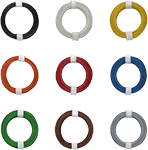
Set bestehend aus 10 Rollen á 10 m Litze in 10 verschiedenen Farben. Je 1x: rot, schwarz, blau, gelb, grün, weiß, violett, orange, braun, grau
- 1-adrig
- 0,04 mm² (5 x 0,1 mm)
- Kunststoff isoliert
- 10 x 10 Meter
- 1-adrig
- 0,04 mm² (5 x 0,1 mm)
- Kunststoff isoliert
- 10 x 10 Meter
Article no.: E-110-MIX
Viewed