


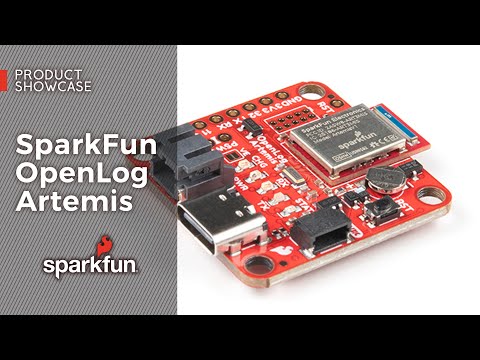

SparkFun OpenLog Artemis
€59.90


Frequently Bought Together
3 items


Description
Product information "SparkFun OpenLog Artemis"
Each OpenLog Artemis includes an IMU for integrated recording of triaxial accelerometer, gyroscope and magnetometer. While the original 9DOF Razor used the old MPU-9250, the OpenLog Artemis uses the latest ICM-20948 from InvenSense, which enables recording of all nine axes at almost 250 Hz. Simply switch on the OpenLog Artemis and all incoming serial data is automatically recorded in a log file, supporting baud rates up to 500000bps! The OLA also has four ADC channels on the edge of the board. Voltages up to 2V can be captured with 14-bit precision up to 1900Hz for one channel and 1000Hz for all four channels. Additionally, based on user feedback, we have added an on-board RTC so that all data can be time-stamped.
The OpenLog Artemis is highly configurable via an easy-to-use serial interface. Simply plug in a USB-C cable and open a 115200bps terminal. The logging output is automatically streamed to both the terminal and the microSD card. Press any button to open the configuration menu.
The OpenLog Artemis automatically scans, recognises, configures and logs various Qwiic sensors that are plugged onto the board (no soldering, no programming!). Automatic detection is currently supported for the following Qwiic products:
- uBlox GPS Module (Lat/Long, Altitude, Velocity, SIV, Time, Date)
- ZED-F9P 1cm high-precision GPS
- NEO-M8P-2 2.5 cm high-precision GPS
- SAM-M8Q 1.5m 72 channel GPS
- ZOE-M8Q 1.5m compact GPS
- NEO-M9N 1.5m GPS
- MCP9600 Thermocouple amplifier
- NAU7802 Load cell amplifier
- LPS25HB Barometric pressure sensor
- BME280 Humidity and barometric pressure sensor
- MS5637 Barometric pressure sensor
- MS8607 Pressure-humidity-temperature sensor
- MPR0025PA Micro pressure sensor
- TMP117 High-precision temperature sensor
- AHT20 Humidity and temperature sensor
- SHTC3 Humidity and temperature sensor
- CCS811 Air quality sensor
- SGP30 Air quality sensor
- SCD30CO2 and air quality sensor
- SN-GCJA5 Particle sensor
- VEML6075 UV sensor
- VCNL4040 Proximity sensor
- VL53L1X LIDAR distance sensor
- ADS122C04 ADC PT100 sensor
- Qwiic Mux enables the linking of up to 64 individual buses!
- MS5837 Depth and pressure sensor
- SGP40 Air quality sensor (VOC index)
- More cards will be added continuously!
Logging with very low power consumption is supported. OpenLog Artemis can be configured to take 500 measurements per second, or as slow as 1 measurement every 24 hours. The choice is yours! If there are more than 2 seconds between measurements, OLA automatically switches itself and the sensors on the bus off, resulting in a quiescent current of approx. 18uA. This means that a normal 2Ah battery will allow recording for more than 4,000 days! OpenLog Artemis has an inbuilt LiPo charge set to 450mA/hr.
As new features are constantly being added, we have developed an easy to use firmware upgrade tool. You don't need to install Arduino or a bunch of libraries. Just open the Artemis Firmware Upload GUI, load the latest OLA firmware and add new features to OpenLog Artemis as they appear!
The OLA can be tailored to many different applications and we will release customised versions of the firmware which you can find on our Documents tab above.
Features:
- Artemis module (Cortex-M4F based Apollo3 microcontroller)
- Configurable via CH340E and Artemis firmware upload GUI
- Operating voltage range
- 3.3V to 6.5V (via VIN with optional external power switch)
- 5V with USB (via 5V or USB type C)
- 3.6V to 4.2V with LiPo battery (via VBATT or 2-pin JST)
- Built-in MCP73831 single cell LiPo charger
- Minimum 450mA charging current
- 3.3V (via 3V3)
- 3.3V to 6.5V (via VIN with optional external power switch)
- Current consumption
- ~20mA (Run)
- ~80µA (Sleep)
- ~18µA (Deep Sleep - controller switched off)
- Connections
- 1x USB type C
- 1x LiPo battery activated
- 1x Qwiic-capable I2C with power control
- 1x SWD 2x5 pin header
- 4x analogue-digital
- 14-bit, up to 1900Hz, 2V max (3.3V compatible)
- Serial
- Acquisition speeds up to 500000bps [1]
- 1x microSD socket
- Support for FAT32 and older FAT16 formats up to 32GB with power control
- RTC with 1mAhr battery backup
- 9-axis IMU logging up to 250Hz
- ICM-20948 via SPI interface
- LEDs
- Power indicator
- LiPo charge indicator
- Serial Tx and Rx
- Status
- Introduction to the SparkFun OpenLog Artemis Hookup Manual
- Circuit diagram
- Eagle files
- Connection instructions
- Board dimensions
- Data sheet (Apollo3)
- Data sheet (ICM-20948)
- Artemis integration guide
- Designing with the SparkFun Artemis
- Artemis development with Arduino
- Arduino Core
- Artemis Forums
- Artemis Info Page
- Qwiic Info Page
- CH340E USB Driver
- Artemis Firmware Uploader GUI
- Current OLA firmware: v1.9
- Geophone logger firmware for recording seismic activity
- GNSS logger for advanced data logging with the uBlox F9 and M9 GNSS modules including support for RAWX and RELPOSNED
- GitHub Hardware Repo
Properties
| Zolltarifnummer: | 85271950 |
|---|---|
| Brand: | SparkFun |
| Country of Origin: | USA |
| EAN: | 4060137066412 |
| Gross Weight (kg): | 0.006 |
| Manufacturer ID: | DEV-16832 |
| Product ID: | DEV-16832 |
Manufacturer
SparkFun
SparkFun – open-source electronics from Colorado
SparkFun Electronics was founded in Boulder, Colorado in 2003 and is one of the defining companies of the maker movement. The idea behind it: electronics should be accessible to everyone. That is why SparkFun publishes the schematics and layouts of its products as open-source hardware and accompanies them with detailed guides and tutorials.
Development and manufacturing take place in the USA. SparkFun is best known for the Qwiic system, which allows sensors and modules to be combined via plug connection without soldering, as well as for the Thing Plus and MicroMod platforms for IoT and embedded projects.
At BerryBase you will find a large selection of genuine SparkFun products – from breakout boards for quick prototypes to development boards for professional applications.
Manufacturer and safety information
SparkFun Electronics
6333 Dry Creek Parkway
DE CO 80503 Niwot
https://www.sparkfun.com
support@sparkfun.com
WEEE number: 17968585
Responsible person for the EU
Sertronics GmbH
Am Studio 20d
DE 12489 Berlin
https://www.berrybase.de
info@berrybase.de
Safety instructions
- Do not bring into direct contact with water or moisture, as the electronics may be damaged.
- Protect against static discharge, e.g. by earthing the work surface.
- Keep away from extreme temperatures and direct sunlight.
- Only install or remove connections and modules using suitable tools.
- Do not use force to insert the module into a connection or socket.
- Before installation, ensure that the power supply is switched off.
- Only operate with the voltage specifications specified by the manufacturer.
- Do not use defective or damaged devices and dispose of them properly.
- Do not dispose of electronic components in household waste; dispose of them in accordance with local regulations for electronic waste.
- Keep components out of the reach of children.
- Check the data logger regularly for software updates to avoid security gaps.
- Store in a dry, cool environment for longer periods.
Reviews 0
Login
Customers also viewed


