



SparkFun MicroMod Environmental Function Board
€139.90
% €178.45 (21.6% saved)


Description
Product information "SparkFun MicroMod Environmental Function Board"
- The SGP40 measures the quality of the air in your room or house. The SGP40 utilises a metal oxide (MOx) sensor with a temperature controlled micro heating plate and provides a humidity compensated, volatile organic compound (VOC) based indoor air quality signal. Both the sensor element and the VOC algorithm are characterised by unrivalled robustness to contaminating gases found in real-world applications, enabling unique long-term stability as well as low drift and device-to-device variation.
- The SHTC3 is a highly accurate digital humidity and temperature sensor. The SHTC3 utilises a capacitive humidity sensor with a relative humidity measurement range of 0 to 100% RH and a bandgap temperature sensor with a temperature measurement range of -40°C to 125°C. The SHTC3 builds on the success of the SHTC1 sensor and offers greater accuracy (±2% RH, ±0.2°C) than its predecessor, allowing for greater flexibility.
- The STC31 measuresCO2 concentrations based on thermal conductivity and has twoCO2 measurement ranges: 0 to 25 vol% and 0 to 100 vol%. The repeatability of the measurement is 0.2 vol%, with a stability of 0.025 vol% / °C. The measurement accuracy depends on the measuring range: 0.5 vol% + 3% measured value; 1 vol% + 3% measured value. Utilising the measurements of the SHTC3, the STC31 is able to provide humidity compensated measurements together with improved temperature compensation. The STC31 can also compensate for atmospheric pressure - which is handy if you're in the mountains like us!
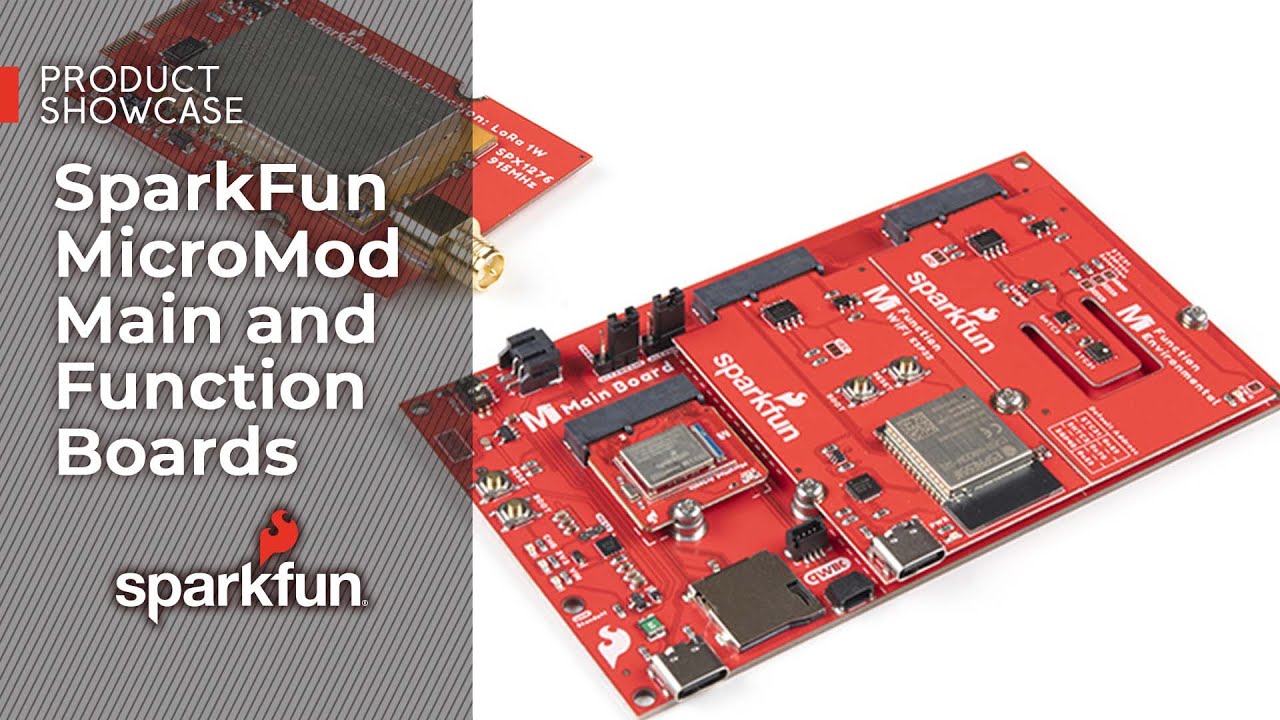
Thanks to our practical M.2 MicroMod connector, no soldering is required to connect it to your system. Simply align the bevelled connector of your processor and function board with the corresponding key of the M.2 connector and then secure them to the motherboard with screws. The MicroMod Environmental Function Board can then be read out via the I2C port. The board is equipped with the AP2112 3.3 V voltage regulator, I2C pull-up resistors, a power LED, a jumper for deactivating the LED and jumpers for alternative STC31 addresses.
Features:
- Input voltage range
- 2.5V to 6.0V
- Typ. 5V via the USB port of the main board
- Type. ~3.7V to 4.2V via the LiPo battery connector of the main board
- 2.5V to 6.0V
- IO voltage
- 3,3V
- AP2112 3.3V voltage regulator (rated power 600mA)
- Power LED
- I2C pull-up resistors
- Sensirion SGP40 air quality sensor
- Uses I2C interface
- Address: 0x59 (default)
- Operating voltage range
- 1.7V to 3.6V (Typ. 3.3V)
- Operating temperature range
- -20°C to +55°C
- Typical current consumption
- 2.6mA in continuous operation (at 3.3V)
- 34µA in idle mode (heating off)
- Output signal
- Digital raw value (SRAW): 0 - 65535 ticks
- Digital processed value (VOC index): 0 - 500 VOC index points
- Switch-on behaviour
- Time until reliable detection of VOC events: <60s
- Time to fulfil specifications: <1h
- Recommended sampling interval
- VOC index: 1s
- SRAW: 0.5s - 10s (Typ. 1s)
- Uses I2C interface
- Sensirion SHTC3 humidity and temperature sensor
- Uses the I2C interface
- Address: 0x70 (standard, not configurable)
- Operating voltage range
- 1.62V - 3.6V (Typ. 3.3V)
- Operating temperature range
- -40°C to +125 °C
- Relative humidity
- Measuring range: 0% to 100%
- Typical accuracy: ±2 %RH
- Resolution: 0.01 %RH
- Temperature
- Measuring range: -40°C to +125 °C
- Typical accuracy: ±0.2 °C
- Resolution: 0.01 °C
- Typical current consumption (varies depending on mode)
- 4.9µA to 430µA (normal mode)
- 0.5µA to 270µA (energy saving mode)
- Enables the STC31 to compensate for humidity and temperature
- Uses the I2C interface
- Sensirion STC31CO2 sensor
- Uses I2C interface
- Addresses: 0x29 (default), 0x2A, 0x2B, 0x2C
- Operating voltage range
- 2.7V to 5.5V (Typ. 3.3V)
- Operating temperature range
- -20 °C to +85 °C
- Calibrated forCO2 in N2 andCO2 in air
- Measuring ranges
- 0 to 25 vol% in N2
- 0 to 100 vol% in air
- Accuracy
- 0.5 Vol% + 3% measured value in N2
- 1 vol% + 3% measured value in air
- Resolution of concentration and temperature: 16-bit
- Repeatability: 0.2 vol%
- Temperature stability: 0.025 Vol% / °C
- Start-up time: 14 ms
- Thermal conductivity sensor provides calibrated gas concentration and temperature output
- Uses I2C interface
- Jumper
- PWR LED
- I2C pull-up resistors
- STC31 address selection
Documents:
Hardware documentation:
- Get Started with the MicroMod Environmental Function Board
- Circuit diagram
- Eagle files
- Board dimensions
- Connection instructions
- SGP40
- SHTC3
- STC3X
- Arduino Libraries
- GitHub Hardware Repo
Properties
| Zolltarifnummer: | 90271010 |
|---|---|
| Brand: | SparkFun |
| Country of Origin: | USA |
| Gross Weight (kg): | 0.005 |
| Manufacturer ID: | SEN-18632 |
| Product ID: | SEN-18632 |
Manufacturer
SparkFun
SparkFun – open-source electronics from Colorado
SparkFun Electronics was founded in Boulder, Colorado in 2003 and is one of the defining companies of the maker movement. The idea behind it: electronics should be accessible to everyone. That is why SparkFun publishes the schematics and layouts of its products as open-source hardware and accompanies them with detailed guides and tutorials.
Development and manufacturing take place in the USA. SparkFun is best known for the Qwiic system, which allows sensors and modules to be combined via plug connection without soldering, as well as for the Thing Plus and MicroMod platforms for IoT and embedded projects.
At BerryBase you will find a large selection of genuine SparkFun products – from breakout boards for quick prototypes to development boards for professional applications.
Manufacturer and safety information
SparkFun Electronics
6333 Dry Creek Parkway
DE CO 80503 Niwot
https://www.sparkfun.com
support@sparkfun.com
WEEE number: 17968585
Person responsible for the EU
Sertronics GmbH
Am Studio 20d
DE 12489 Berlin
https://www.berrybase.de
info@berrybase.de
Safety instructions
- Keep the board away from water, moisture and conductive materials to avoid short circuits.
- Avoid overheating and only operate the board at the recommended temperatures.
- Only use the product with compatible power supply units and connections.
- Do not connect any live connections and never disconnect them by force.
- Wear antistatic measures when working with electronic components to prevent damage caused by ESD (electrostatic discharge).
- Store the board out of the reach of children, as small parts could be swallowed.
- Dispose of the board in accordance with local regulations for electronic waste, do not dispose of it with household waste.
- Always disconnect the device from the power supply before cleaning or repair.
- Observe the safety and liability disclaimers in the manufacturer's original documentation.
Reviews 0
Login
